

Dr. David Hailey, 6/30/2025
This will take a revolution.
... but as it happens, that revolution has already begun. It is nearly unnoticeable, but it is here. You can see it in the fact that in 2024, while nobody was looking, renewable energy (27%) passed natural gas (24%) as the number one energy provider around the world, and in the United States, on average, more than 50% of our electric energy is clean (renewable or nuclear). The revolution can be seen in the fact that in the United States, greenhouse gas (GHG) emissions have dropped by around 30% since 2005, and in the same period, emissions from coal dropped by around 50%.
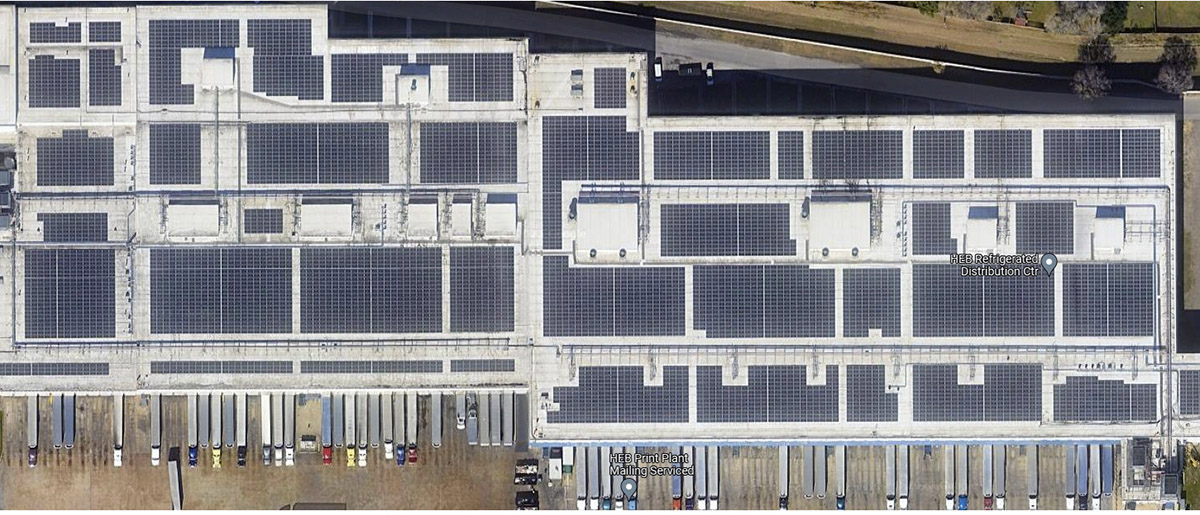
But the evidence doesn’t just show up in the statistics. The revolution can be seen in the fact that it is getting hard to drive through a neighborhood in the United States without seeing solar arrays on rooftops, and that doesn’t count the arrays you can’t see on the flat-topped roofs of businesses, condominiums, and the like. Solar panels on the flat rooftops of industries and condos number in the tens of millions. Large solar farms tend to be located remotely, but they sport hundreds of millions of panels that produce ~131 billion Watts powering approximately 26 million homes.
You can see the revolution in the fact that so many people are buying EVs (30% of all new cars sold worldwide) and are willing to wait in line for two or more years for their first EV – foregoing the test drive. In some more progressive cities, Teslas are popping up everywhere you look, and even more EVs pass by unrecognized because they look identical to their fossil-fuel-burning brethren. Moreover, if you look into a hotel or shopping center parking lot, you will likely see EV charging stations.

According to the International Energy Agency (US IEA), “The share of electric cars in total sales has more than quentupled in four years, from around 4% in 2020 to 14% in 2022 to 21% in 2023 and 25% by the end of 2024.”
Green energy in the United States
is growing exponentially.
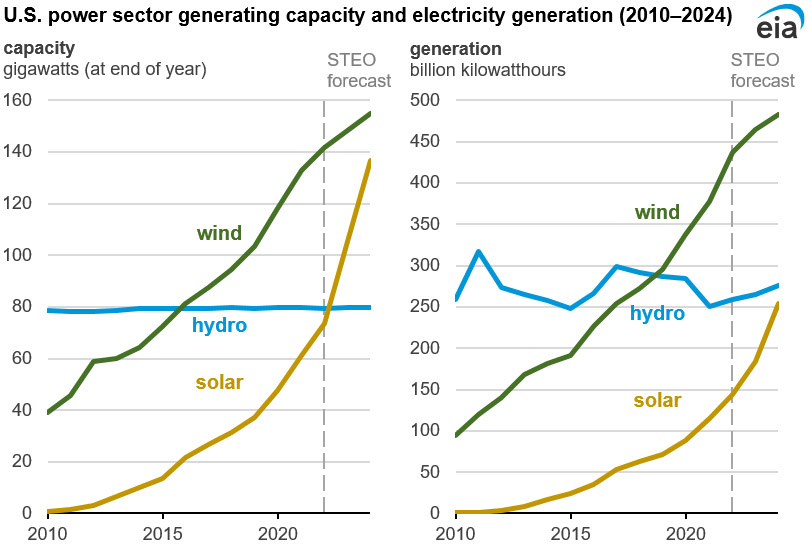
Grid-based solar in the United States: In the United States, solar rose by 22 billion Watts in 2022 and by 33 billion watts in 2023 (up by more than 50%). According to Secretary of Energy Jennifer Granholm, “Solar is our cheapest and fastest-growing source of clean energy, and it could produce enough electricity to power all of the homes in the United States by 2035, as the solar increases employment by as many as 1.5 million people in the process.” (ICYMI: Secretary Granholm Visited Maine and New Hampshire to Tour Renewable Energy Infrastructure | Department of Energy)
Household solar in the United States: When 66 Watt solar panels were $450 each, solar was an expensive hobby for the rich, with virtually no return on investment (ROI). Today, most families with a roof can afford 450 Watt solar panels at around $200 each. If you search on Google, you will find that the ROI of solar is around 10%. That is old news. With the reductions in solar costs and the 30% Federal tax rebate, the current ROI ranges from 15% to nearly 50% per year. The ROI of solar depends on the cost of installation plus the number of bright hours per year in your region, compared to the price of your electricity ($0.12/kWh in Austin as opposed to a maximum of $0.45/kWh in San Diego). Because installation costs are currently reduced by the United States Federal tax credit, a $20,000 investment is really ~$12,500 after you receive your tax rebate.
In some parts of the United states,
wind is already the number one energy source.
Effective in 2024, wind power was the largest renewable energy source in the United States, with more than 100,000 turbines in a total of ~20,000 wind farms in 44 states. They produce ~200 billion Watts per hour (~200 gigawatt hours or ~200gWh).
This points to an interesting phenomenon. In conservative states, many politicians oppose renewable energy growth because it reduces profits for the fossil fuel industry. As of this writing, Senators Ted Cruze and John Cornyn, along with Governor Greg Abbot of Texas, still deny that the climate is changing and insist there is no reason to abandon fossil fuels. And yet, according to Time Magazine,
From sea level rise and hurricanes to extreme heat, Texas is one of the most threatened states in the United States wh;
en it comes to the impacts of climate change. It ranked first in the number of billion-dollar disasters per year since 2001, and a 2020 analysis by ProPublica and The New York Times of America’s 3,000 counties revealed that, of the 135 counties deemed most at risk from a changing climate, 24 are in Texas. As Texas Boils, Climate Denying Politicians Seek Federal Aid | TIME MAGAZINE
Ironically, despite all the political foot-dragging, Texas leads the nation in wind energy production, having more wind energy than the next three states. Thirty-eight percent of Texas energy is renewable – not because it is politically expedient, but because it is the most cost-effective energy source – it’s good for business, and good businessmen understand “good for business.”
Why do things seem so bleak?
We currently live in an economy that is causing our climate to become increasingly dangerous. We rightly worry that things are going in the wrong direction, but we are ordinary people without the means to make significant changes (that is if we knew what to change). We do not see how we can do much to stop the damaging processes . . . in fact, apart from the most obvious of them, we likely don’t even know what the most damaging processes are. Briefly, our worst problems are liquid fossil fuels, but liquid fuels are not a difficult fix.
We have been able to make liquid fuel out of all kinds of things that do not involve petroleum since the 1930s. We can replace gasoline with renewable fuel. We can even make liquid fuel out of air and water, but if we make liquid fuel out of anything but petroleum, we are taking money out of the pockets of the fossil fuel industry. Being the most powerful financial forces on the face of the Earth, the petroleum industry will not stand for replacing fossil fuel and has fought to block transition to renewables since 1989.
We face the wealthiest corporations in the world, and they are in real trouble.
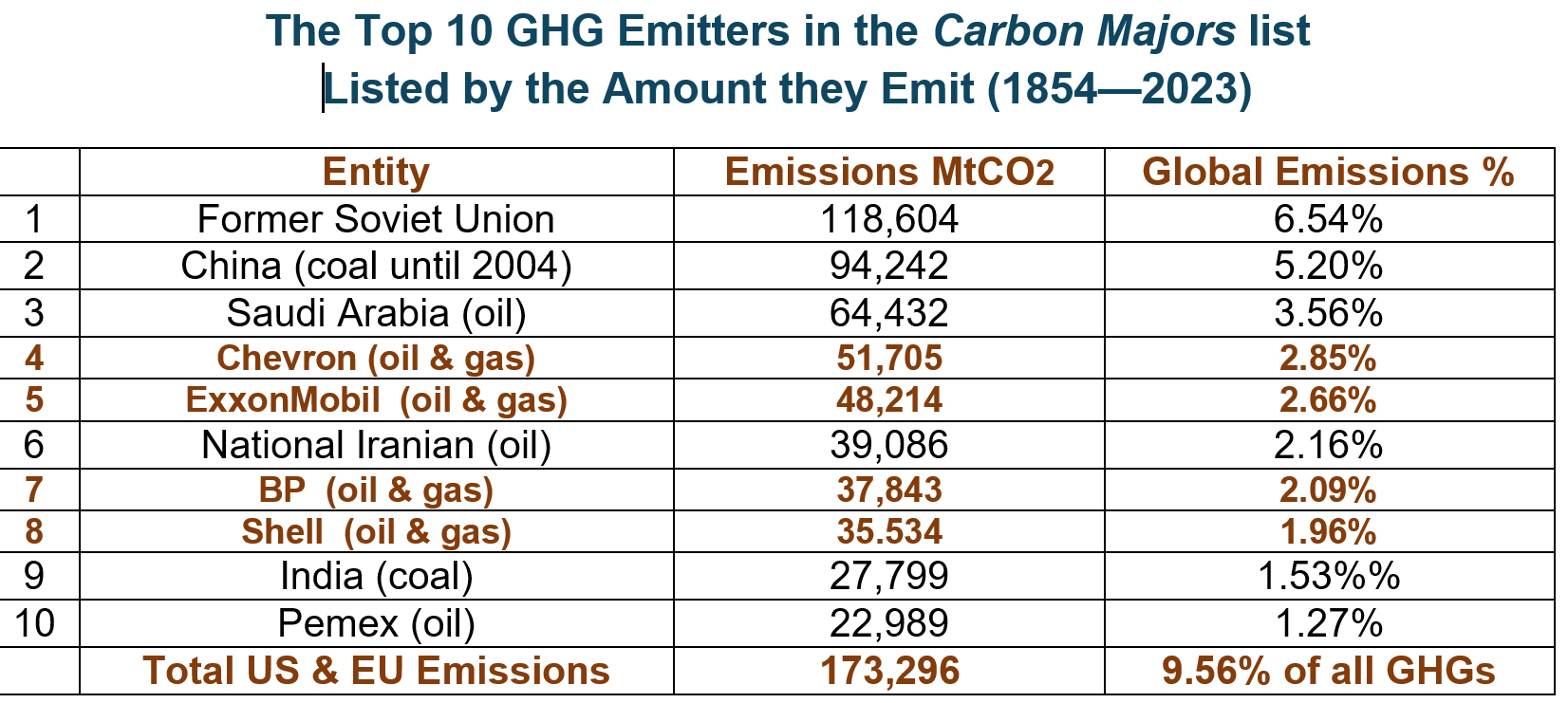
The fossil fuel industry has known that the climate has been changing for the worse since before the 1980s, but have done whatever it takes to keep us from responding to the emergency. Of the ten biggest polluters on Earth, four of them are among the largest polluters in the United States: Chevron, BP, Shell, and ExxonMobil.
For many of our politicians, climate change is important, but they have many more pressing problems. On the other hand, many of our politicians are completely hostile to the idea of mitigating global warming. Many of them have huge portfolios of fossil fuel stocks, and some politicians are in the pockets of fossil fuel companies.
So, what can we do?
We begin by becoming informed. We don’t do things because we think they are right – we do things because we know they are right. The point of this book is to give you enough information to permit you to make informed decisions.
Here is an excellent example of people making an uninformed decision: In most supermarkets, we currently have the choice of paper, single-use plastic, canvas, or multi-use plastic bags. Which to choose? The answer is, “it depends.” Current wisdom on the street is to get reusable canvas bags and carry them to and from the store. But cotton for these canvas bags is commonly grown in India. The fabric is woven in Thailand or Vietnam. The bags are manufactured in China, possibly using child labor (and sometimes, slave labor in work camps). Finally, they are shipped across the Pacific ocean and trucked across the U.S. Not one thing in that scenario is suatainable. United States Department of Labor (dol.gov)
On the other hand, companies like Trex Decking upcycle old single-use plastic bags into decking materials, while misinformed people in cities and states across the country, insist that single-use plastic be removed from supermarkets, and that people begin using canvas bags. Trex
Should you be anxious about the future?
You should be anxious about the future, but things are not as bad as many suspect. That will be the goals of this website -- show you where the problems are and where to find the paths through or around them -- to point out where we really are in our quest for a sustainable future and how we will get to where we need to be. We need to emit fewer GHGs, but we do not have to stop emitting them altogether, and we have some time.
Climate change is a trend, and so is climate change mitigation.
The critical thing to remember is that global warming is a trend and not a switch. In the future, the closer we get to a zero-carbon footprint, the slower the upward warming trend will be. Once we reach a negative carbon footprint, we will begin a cooling trend. A below-zero carbon footprint would mean taking more carbon out of our biosphere than we put into it.
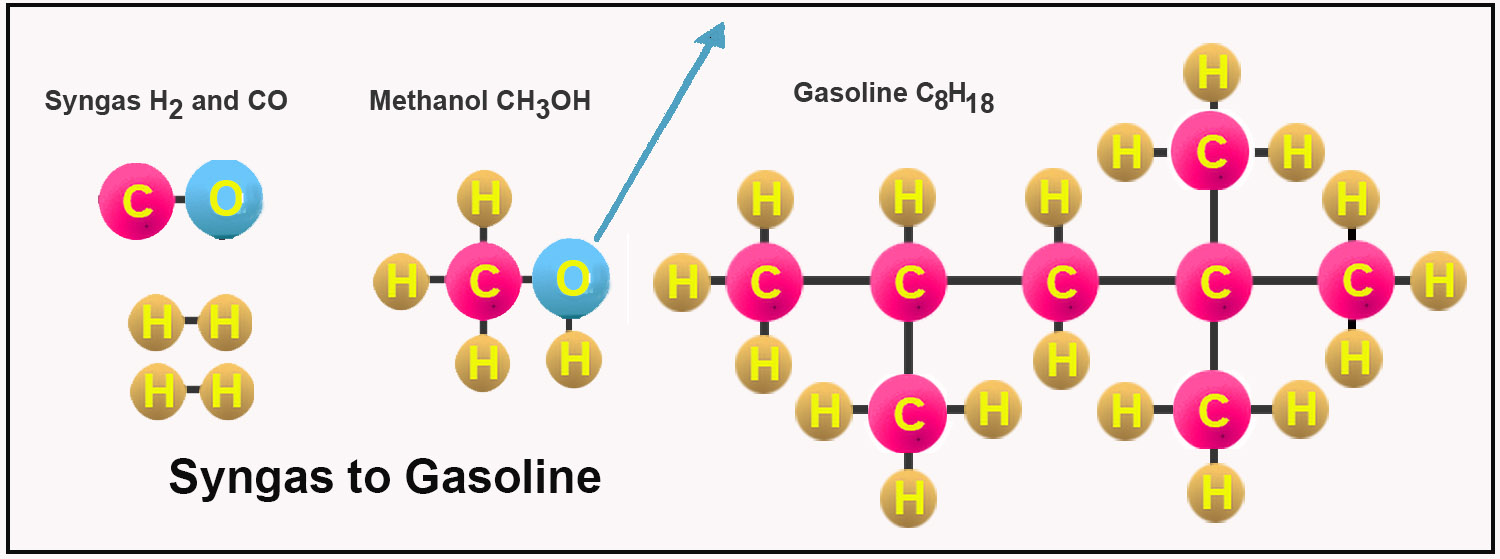
Taking more GHGs from our biosphere than we put into it may seem impossible, but it is not. Throughout this book, I will introduce any number of options that involve taking more GHGs from the atmosphere than we put into it. For example, wind and solar put no CO2 into the atmosphere but take none out. Making biofuels, however, leaves a great deal of carbon waste that can be sequestered. The cycle might look like: 1. take CO2 out of the atmosphere using plants, 2. pull carbon out of the plants to make synthesis gas (syngas), 3. combine the syngas with hydrogen to make methanol, 4. remove the oxygen molecules from the methanol and process it to make gasoline, 5. sequester any waste carbon (usually charcoal) for a less than zero carbon footprint. This is one method, There are many more similar fuels in use. The reason we don't know about them is because the oil industry spends billions pushing them into obscurity.
Electric trucks will be used for delivery. Long-haul trucks will run on biofuels with a less than zero carbon footprint. You see them every day. You just don’t know they are running on biodiesel. You might ask why they are running on biodiesel? It's cheaper.