
An Overview of How We Can Use EVs and Renewable Fuel to Reverse Climate Change.
September 25, 2025 David E. Hailey, Ph.D.
The Transportation Sector in the United States accounts for roughly one-third of all U.S. greenhouse gas emissions. Of that, light-duty vehicles (the ones we drive every day) are responsible for about 57% of the Transportation Sector’s carbon footprint. That translates to approximately 3.6 billion metric tons of greenhouse gases (GHGs) per year, or nearly 10 million metric tons per day.
We are the problem with the transportation sector.
The largest sources of greenhouse gas emissions in the world aren’t power plants or industrial complexes; they are the 340 million of us, going to school, to work, picking up groceries, running daily errands, living our daily lives, and while we might hear suggestions such as, “stop driving so much, walk more, catch the bus, or use your bike,” those are simple-minded answers to truly complex problems. Moreover, those “solutions" are designed to distract us from the real problem – the fuel the oil industry sells us to power our cars.
Most Americans don’t live in walkable cities with robust public transit. We live in a country that spans nearly 3,809,525 square miles, coast to coast, and our communities are spread across that space. For most of us, driving isn’t a choice—it’s a necessity. As President Clinton famously said, “It’s the economy, stupid.” He was right. Our economy is built on mobility. If we all stopped driving tomorrow, the economy would collapse, and we would probably starve.
 Figure 1: Teledyne’s Forward-Looking Infrared (Flir) camera allows us to see CO2 when it would otherwise be invisible. The above photo was shot of a city bus in heavy traffic in broad daylight. The CO2 is so thick, we can make out only a tire (which, as we all know, is made of carbon). This is what downtown in any major city would look like, if we could see CO2. This is what we breathe as we navigate a city.
Identifying the carbon debt of a vehicle
The carbon impact of vehicles differs. In some cases, the largest carbon impact comes from its manufacture, while in other cases, most of the impact comes from its use. All autos incur huge carbon impacts during the manufacturing process:
- There is the extraction of minerals to make metals and plastics . . .
- Transportation of these materials to manufacturing.
- Parts are manufactured around the world and . . .
- Shipped to a central assembly plant, where they are. . .
- Assembled into a car or truck, and are . . .
- Shipped, with a massive carbon debt, to a dealer.
Our contribution to the Transportation Sector’s carbon footprint depends on the lifecycle carbon impact of the car we buy. In the case of a vehicle with an internal combustion engine, the huge manufacturing debt is only a down payment for a carbon debt that never stops growing (17,000 pounds of CO2 per year on average). In the case of an EV being charged from household solar, the debt is paid off in a couple of years, and from then on, the car only becomes cleaner. You count a battery-powered EV’s vehicle contribution to mitigating climate change by the 17,000 pounds of CO2 per year that everybody but you is emitting.
So, EVs might seem like the perfect solution, but they are not.
A common assumption is that if we all got EVs, our GHG problems would be solved. Unfortunately, that solution only works for some people. Economists, futurists, and sociologists agree that electrification is a critical pathway towards decarbonization. But battery electric vehicles (BEVs) aren’t a one-size-fits-all solution. Only 48% of Americans can reasonably realistically own and maintain a BEV. The majority of Americans live in apartments, condos, mobile homes, rental units, RVs, or even vans (all places where home charging is usually impossible).
Owners of internal combustion engine (ICE) vehicles can refuel in around five minutes and gain 350 miles of range. In contrast, I can add 150 miles to my BEV in about two hours in my garage with a level 2 charger. Moreover, I can charge from solar and battery sources, so I don’t even have to pay for the electricity. Unfortunately, without the garage and charger, I’d be looking at a 30-minute drive to a public charger, an hour (or more) to charge, and another 30 minutes back.
There may come a time and place when every household, regardless of housing type, can charge an EV affordably and conveniently, but that time and place isn’t anywhere or anytime soon. Currently, 52% of U.S. drivers must find an alternative solution.
A second, less simple-minded, option is a hybrid vehicle.
Hybrid electric vehicles (HEVs) offer a practical solution for those who can’t reasonably own a BEV. While they’re still powered by an internal combustion engine (technically making them ICE vehicles), they get at least 50 miles per gallon (and up to 100 MPG), so they split the difference between BEVs and ICEVs. The Intergovernmental Panel on Climate Change aims to reduce global emissions by as much as 50% by 2030. Since hybrids already do that, if you acquire one, you will have taken a good step in the right direction.
In short, if you live in an apartment or dorm or the like, and park your car among all those others on the lot, an HEV can be an excellent choice.
PHEVs take the solution a step further
If you have access to a 120 socket, a PHEV might be a good choice. A 120 VAC socket provides around four miles of range per hour charged. Ten hours of charge will provide around 40 miles of range. That’s more range than most PHEVs offer, so if you come home and plug your car in, by morning it will be fully charged. That gives you 25 to 45 miles of electric range – enough for many people to commute without using a drop of gasoline. If your round-trip to work is under 20 miles and you only run a few errands, you might go weeks without burning fuel (though you’ll still need to use some gas occasionally – otherwise it goes stale). In any case, some PHEVs can deliver more than 100 MPG, and that’s a good start.
A big question might be, “Can an HEV or PHEV be an even better choice than a BEV?"
Suppose you live in Texas. This past year (2024), Texas installed more wind turbines than all of the other states in the United States. Still, more than half of its electric power comes from coal (13%) and natural gas (40%). If you charge your BEV into the grid, the 53% carbon emissions from creating the electricity become part of your car’s carbon legacy. That impact makes your BEV a hybrid, of sorts (a mix of fossil fuel and green energy power). Briefly, the carbon footprint of your BEV will be driven by the grid you are plugged into. But what if you also had a hybrid or plug-in hybrid that you could fill with E85? Your hybrid could be cleaner than your BEV.
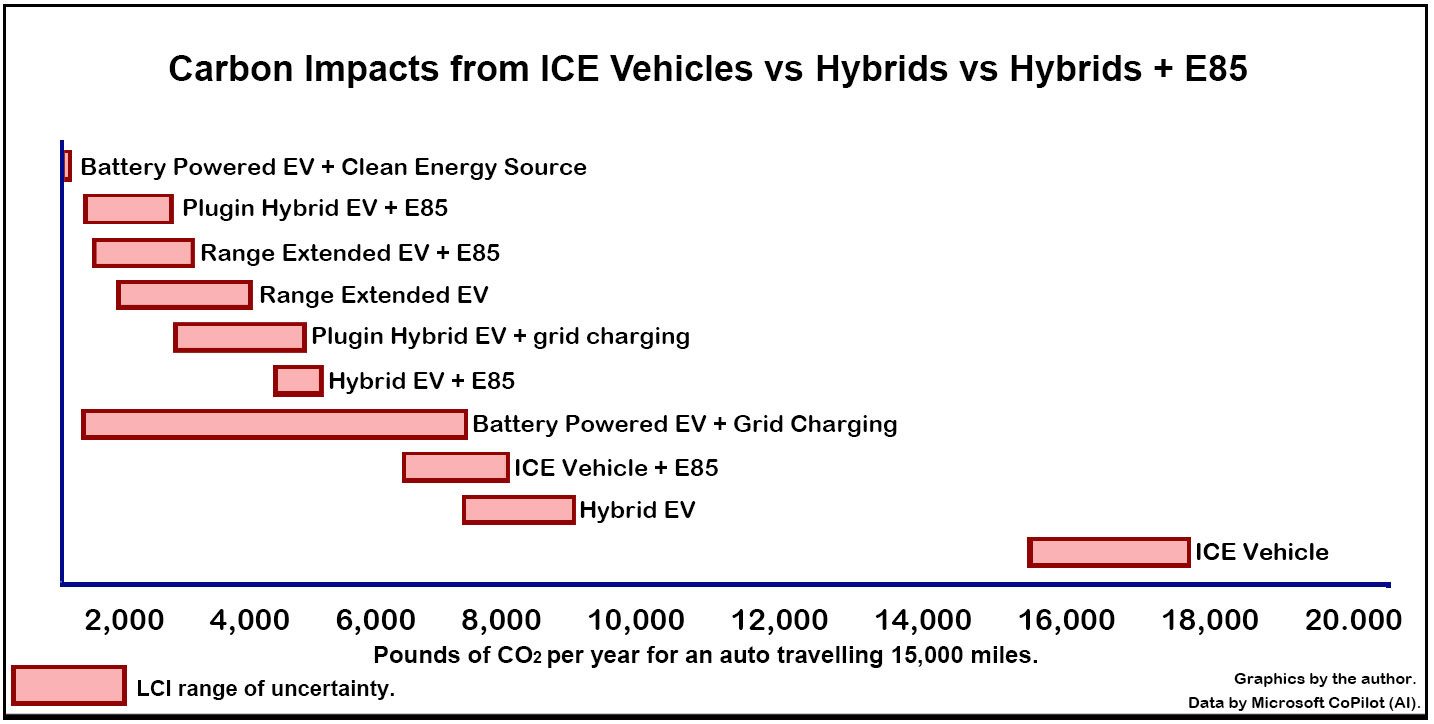 Figure 2: Vehicle lifecycles vary greatly, depending on the circumstances under which the vehicles are used, so that a BEV, while usually a great choice as a vehicle, is not always such a great choice. In this image, a BEV charging from the grid might be almost as clean as a BEV charging from solar, but it might also be about as clean as a full-scale ICE pickup running on flex fuel. The life cycles of the above vehicles indicate their best and worst cases, measured in pounds of GHGs emitted per year, for an auto travelling 15,000 miles.
In the chart above, one benchmark involves driving an ICE vehicle burning gasoline for 15,000 miles. The carbon impact is determined by how the driver drives. Some drivers consistently accelerate hard and brake just as hard. They have lousy gas mileage. Other drivers tend to treat their vehicles gently, accelerating slowly and coasting before having to brake. These drivers will get much better gas mileage and fewer emissions. The range of impact is approximately 15,500 to 17,500 pounds of CO2 per year if they drive 15,000 miles.
A second benchmark comes from a BEV charging from the grid. The carbon impact of that vehicle depends on the grid. In West Virginia, more than 90% of the fuel for that power is coal. In Texas, around 55% of that power comes from natural gas and coal. Vermont energy comes from biomass and is 95% clean.
Moreover, they come with a lifecycle carbon impact, so their footprint is only nearly perfect.
BEVs charged from the grid, BEVs charged from clean sources, and ICE vehicles running on gasoline give us benchmarks that allow us to compare all of the vehicle options and their relative lifecycle carbon impacts.
An HEV will have from 8,000 to 9,500. That makes it around 50% better than an ICE vehicle and around 10% worse than a BEV charging from the grid. On the other hand, a PHEV will range from 2,500 to 4,500. That makes a PHEV fully comparable to a BEV plugged into the grid. One conclusion we can draw from this is HEVs and PHEVs are perfectly acceptable substitutes for a BEV, if you cannot reasonably own a BEV.
But what happens when we add E85 to the mix?
You might know E85 as “flex fuel.” Essentially, E85 is a blend of 85% ethanol and 15% gasoline. As it shows in the graph above, substituting gasoline with E85 improves the footprint of all hybrids significantly.
When flex-fuel hybrids become an option, for someone who lives in an environment that precludes reasonable ownership of a BEV, a flex-fuel hybrid may be just as good. Some people might live in condos or townhouses, or similar environments where a car might be charged, even from a 120V circuit. For them, a plug-in hybrid is even better.
Add renewable liquid fuel.
Some companies have developed technologies that permit them to synthesize fuels with molecules identical to the original, petroleum fuels. For example, suppose we have a scenario where farmers in the Midwest cultivate with electric tractors powered by solar. And suppose they harvest field corn as sustainably as possible. The corn would have removed huge quantities of CO2 from the atmosphere with few emissions of CO2 from the farm equipment. Now, suppose the corn is converted into ethanol using solar energy, and half of the byproducts are sequestered. In such a scenario, the Carbon Impact of that fuel could be well below zero. In theory, the fuel could put as little as half the CO2 that was taken from the atmosphere back into it.
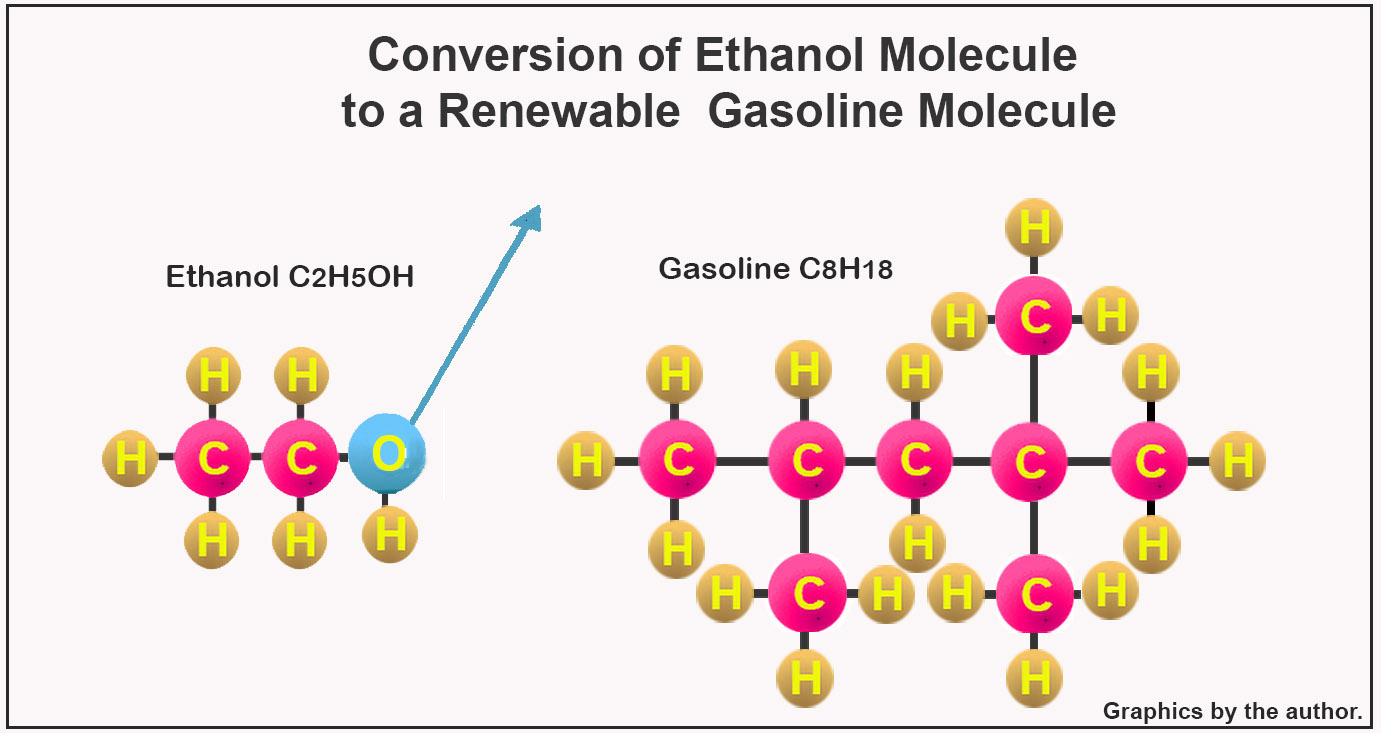 Figure 3: Renewable gasoline can be made from any number of feedstocks. The R-gasoline in the image above can made from ethanol distilled from fermented plants such as corn, sugar cane, switch greass, or even woodchips. Used cooking oil and animal fats such as tallow can be converted into renewable gasoline. Even air and water can become gasoline.